
Loose Dental Implant Crown: What Causes It and How Is It Fixed?
A Real Patient Case at Deccan Dental
Dental implants are one of the most reliable options for replacing missing teeth. With proper care, they can function successfully for many years. However, while the implant itself may remain firmly anchored in the jawbone, the components supporting the crown can occasionally loosen, wear, or fracture.
At Deccan Dental, we recently treated a patient who experienced a sudden loosening of an implant crown while eating. What initially appeared to be a loose crown turned out to be a fractured abutment screw.
Fortunately, we were able to retrieve the broken screw and preserve the existing implant.
This case illustrates an important point: A loose implant crown does not necessarily mean that the implant has failed.
Understanding the Parts of a Dental Implant
A dental implant restoration typically consists of three main components:
- The dental implant: A titanium or titanium-alloy fixture surgically placed into the jawbone that serves as an artificial tooth root.
- The abutment: A connector that attaches to the implant and supports the crown.
- The implant crown: The visible, tooth-shaped restoration that replaces the missing tooth.
In many implant restorations, a small screw secures the abutment to the implant. Although small, this screw plays a critical role in maintaining the stability of the restoration.
Over time, mechanical stress, excessive biting forces, component wear, or other factors can cause the screw to loosen or fracture.
When this happens, the crown may begin to move even though the implant itself remains stable within the bone.
A Patient Case: A Sudden Pop While Eating
Our patient had received an implant crown a little over a year earlier while overseas.
While chewing, the patient heard a distinct "pop" and immediately noticed that the implant crown had become loose. The area was mildly tender, and the crown was moving considerably.
The patient's general dentist referred them to our office for further evaluation and treatment, as the suspected screw fracture required specialized retrieval instruments.
Evaluating the Problem
Before beginning treatment, we discussed the possible findings and treatment options with the patient.
If the screw had simply loosened, it might have been possible to remove it, evaluate the components, and secure the restoration with a replacement screw.
If the screw had fractured, however, the broken portion would need to be carefully retrieved from inside the implant.
This distinction is important because a fractured screw can be more challenging to manage. The goal is to remove the fragment without damaging the implant's internal threads or connection.
We also explained that if the fractured screw could not be retrieved safely, the implant might no longer be restorable.
Treatment: Removing the Fractured Implant Screw
After administering local anesthetic, we created a small access opening through the existing crown to reach the screw channel.
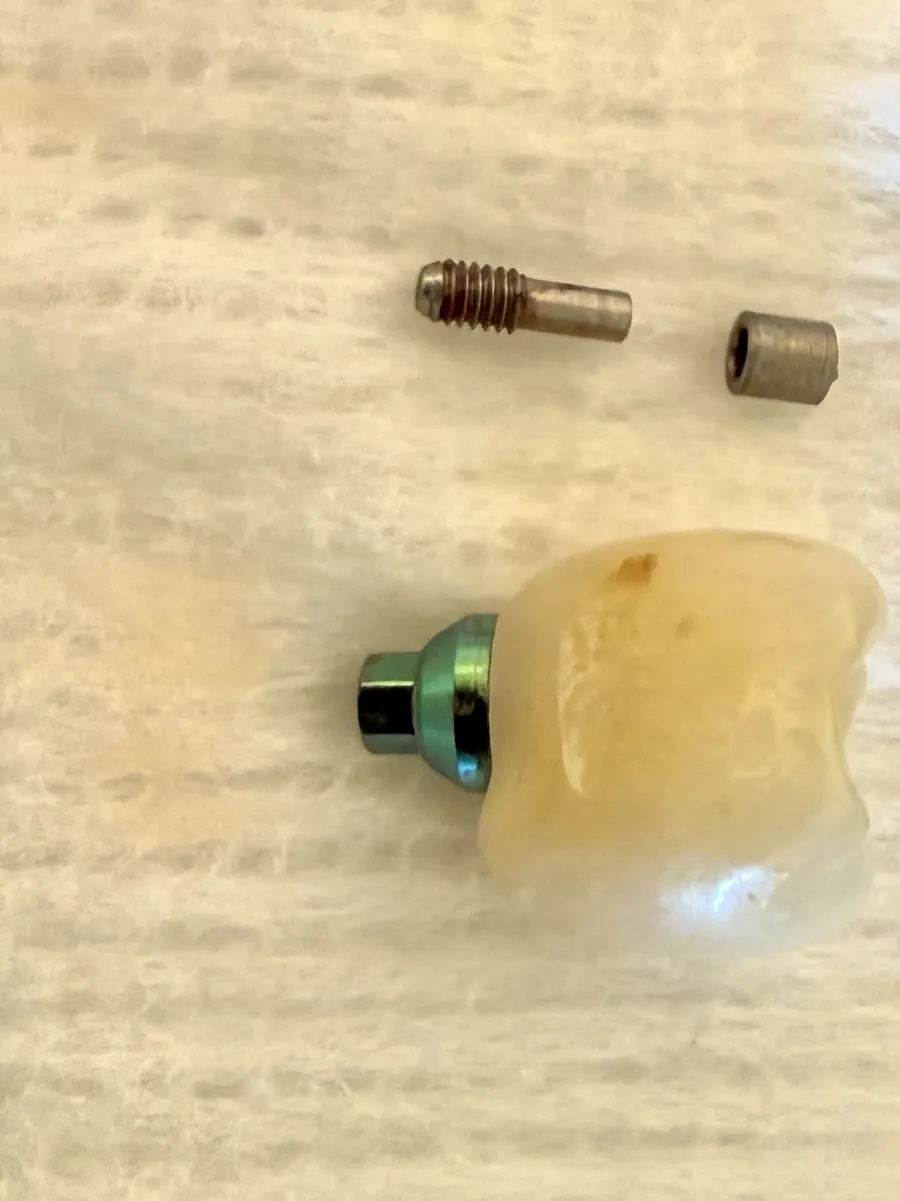
Once the crown and attached abutment were removed, we confirmed that the abutment screw had fractured. A substantial portion of the screw remained lodged inside the implant.
Using a specialized screw retrieval kit designed for the implant system, we carefully engaged and backed out the fractured fragment.
The procedure required precision to avoid damaging the implant's internal connection.
After successfully retrieving the screw, we inspected the implant and confirmed that its connection remained intact. A healing cap was then placed to protect the implant until a new restoration could be fabricated.
The Outcome: Saving the Existing Implant
The good news was that the implant itself remained stable and could be preserved.
Although the existing crown would need to be replaced, the patient did not require removal of the implant or another implant placement surgery.
The next step is to fabricate a new implant crown with appropriately selected components, proper fit, and carefully controlled biting contacts.
The patient can have this completed at Deccan Dental or return to their referring dentist for the final restoration.
By identifying the cause of the problem and successfully retrieving the fractured screw, we were able to preserve the patient's existing implant and avoid a much more involved treatment.
Frequently Asked Questions About Loose Implant Crowns
1. Why is my dental implant crown loose?
A loose implant crown can have several causes, including a loosened abutment screw, a fractured screw, loss of the cement holding the crown, or damage to the restoration itself.
Less commonly, movement may indicate a problem with the implant fixture or the surrounding bone.
A clinical examination, often accompanied by dental X-rays, helps determine which component is responsible.
2. Does a loose implant crown mean my implant has failed?
Not necessarily.
In many cases, the implant remains firmly integrated into the jawbone, and the problem is limited to the crown, abutment, or connecting screw.
These mechanical complications can often be treated without removing the implant.
However, if the implant fixture itself is mobile, the situation is more serious and requires prompt evaluation.
3. Can a broken implant screw be removed?
Often, yes.
Specialized screw retrieval instruments allow dentists to remove many fractured abutment screws without damaging the implant.
The difficulty depends on the location of the fracture, the implant design, and whether the broken fragment can be safely engaged.
Some cases are straightforward, while others require advanced techniques or may not be retrievable.
4. Can my existing implant crown be reused?
Sometimes.
If the crown, abutment, and implant connection are undamaged, the restoration may be reusable after the underlying problem has been corrected.
However, a new crown may be recommended if there is damage, poor fit, inadequate component compatibility, or concerns about the forces contributing to the original failure.
5. Is removing a fractured implant screw painful?
The procedure is generally well tolerated.
Local anesthesia may be used for patient comfort, particularly when access to the screw requires manipulation of the surrounding tissues.
Most of the work involves the mechanical components of the implant rather than the jawbone itself.
6. What should I do if my implant crown suddenly becomes loose?
Contact your dentist promptly for an evaluation.
Until your appointment:
- Avoid chewing on the affected side.
- Do not attempt to tighten or reposition the crown yourself.
- Avoid hard or sticky foods that could dislodge the restoration.
- If the crown comes off completely, keep it in a clean container and bring it to your appointment.
Do not continue chewing on a mobile implant crown, as this may increase the risk of additional component damage. A loose restoration can also become a choking or aspiration hazard.
7. How can I prevent my implant crown from loosening again?
Although not every complication can be prevented, regular dental examinations and proper maintenance can reduce the risk.
Your dentist may evaluate the fit of the restoration, the condition of the implant components, and the forces placed on the crown during chewing.
Patients who grind or clench their teeth may also benefit from an appropriately designed night guard.
Using compatible implant components and following the manufacturer's recommended tightening protocol are also important when placing or replacing an implant restoration.
8. How common are loose or broken implant screws?
Screw loosening is the most common mechanical problem with single implant crowns.1,3 A large review found that about 12.7% of single implant crowns had a loose screw or abutment within five years,1 and a more recent review places the rate between 7% and 11%.2
Broken screws are much less common, at roughly 0.35% to 0.6%.1,2 The implants themselves have a strong track record, with about 97% still in place after five years.1
9. What causes an implant screw to break?
Most screw fractures begin with a screw that has already loosened.4 Once the screw loses its tightness, each bite places repeated stress on it, and over time that stress can cause it to break.
Other contributing factors include a restoration that does not fit precisely, heavy biting forces or grinding, a screw that was not tightened to the manufacturer's specification, and components that were not designed for that implant system.4
10. What if the broken screw cannot be retrieved?
If the fragment cannot be removed safely, there may still be options. Depending on the situation, the internal threads may be repaired, or a custom post may be made to fit the remaining connection.4
In some cases, the implant cannot be restored. It may then be left in place beneath the gum or removed and replaced. These possibilities should be discussed before treatment begins.
11. How do I find out which implant system I have?
Ask the dentist or surgeon who placed the implant, or check any implant card or records you received. This matters because screws and retrieval instruments are specific to each implant brand and system.
If your implant was placed at another office or outside the U.S., an exam and X-rays can often identify it, but bringing your records helps.
When to Seek Professional Help
If your implant crown feels loose, moves when you chew, or makes an unusual clicking sound, it is important to have it evaluated before further damage occurs.
A loose crown does not always mean a failed implant. In many cases, timely intervention can preserve the existing implant and simplify the treatment needed.
At Deccan Dental in San Mateo, California, we evaluate and manage dental implant restoration complications, including loose crowns, fractured abutment screws, and damaged implant components.
Our goal is to identify the underlying problem, preserve healthy implants whenever possible, and restore comfortable, reliable function.
For Referring Dentists
If a patient has a loose implant crown or a fractured abutment screw and you do not have retrieval instruments for that implant system, you can refer the patient to us. We will manage the retrieval and return the patient to you for the final restoration.
References
- Jung RE, Pjetursson BE, Glauser R, Zembic A, Zwahlen M, Lang NP. A systematic review of the 5-year survival and complication rates of implant-supported single crowns. Clin Oral Implants Res. 2008;19(2):119-130. doi:10.1111/j.1600-0501.2007.01453.x
- Katsavochristou A, Koumoulis D. Incidence of abutment screw failure of single or splinted implant prostheses: a review and update on current clinical status. J Oral Rehabil. 2019;46(8):776-786. doi:10.1111/joor.12817
- Goodacre BJ, Goodacre SE, Goodacre CJ. Prosthetic complications with implant prostheses (2001-2017). Eur J Oral Implantol. 2018;11(Suppl 1):S27-S36. PMID: 30109297.
- Nayana P, Nayak SS, Chatterjee A, Sivaraman K, Srikanth G, Singh C. Retrieval of fractured implant abutment screws: a narrative review. J Int Soc Prev Community Dent. 2022;12(3):287-294. doi:10.4103/jispcd.JISPCD_318_21
This article is for general information and is not a substitute for a dental examination. Case details are shared without identifying information.
Concerned about a loose dental implant crown?
Contact Deccan Dental to schedule an evaluation and learn about your treatment options.